


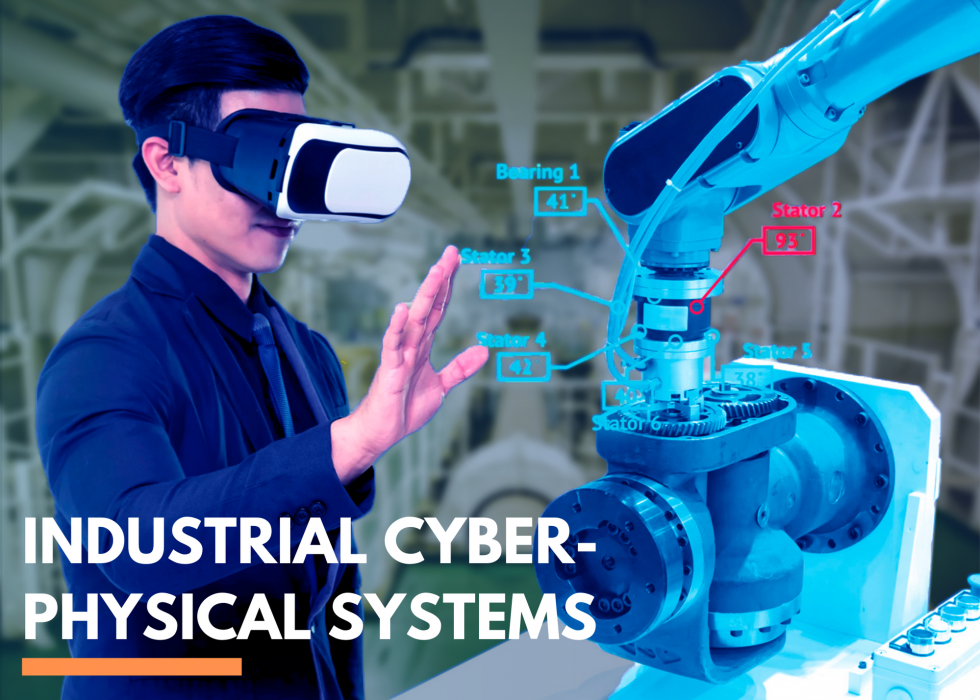
Industrial Cyber-physical Systems (ICPS) cover the design, modeling, and analysis of cyber-physical systems with special emphasis on industrial applications.
The Industry 4.0 paradigm and the issues associated with the digital transformation of the industry can be considered a special case of ICPS.
One of the scientific-technical pillars to deal with ICPS modeling and control is computational intelligence and all the methods and techniques grouped within the intelligent control.
At present the great development of information and communication technologies as well as the convergence of physical and cybernetic systems have contributed to the transformation of traditional embedded systems into cyber-physical systems (CPS) with special cases of applications in industry ( ICPS). CPS are characterized by the close integration and coordination between physical processes and computer systems through network communication of all its components. (Park KJ, Zheng R, Liu X, 2012).
In this way, CPS are not only complex and large-scale systems, but also decentralized, distributed and with heterogeneous and semi-autonomous networked elements or components. The heterogeneity lies not only in the dynamic issues but also by the great diversity of technologies and highly software-intensive implementations. Emergent behavior is another important differentiating feature of CPS, in which large scale does not necessarily have geographic significance. That is, a system of systems can be a local entity with subsystems.
An essential role in CPS is played by intelligent systems for modeling, control and simulation, essential for cooperative and distributed control over wired or wireless communication networks, optimization and decision making at the highest level.
Today’s industry, immersed in the fourth industrial revolution, already has high production and quality standards, as well as new highly complex processes that have brought with it the need for the use of new fuzzy and neuroborough control techniques already applied successfully in sectors such as manufacturing.
ICPS emerge with the potential to surpass predecessor paradigms (eg, flexible manufacturing systems) in order to achieve greater efficiency, security, scalability, sustainability, adaptability, and robustness of embedded and networked systems in which software is intensively used. These features offer the possibility of large-scale systems with faster, more accurate, reliable and efficient responses. For example, the creation of intelligent transport systems that due to their rapid response can avoid numerous traffic accidents, energy networks with greater efficiency, robots that can perform surgeries with greater precision, manufacturing lines with better quality products and greater efficiency.